

Technical Specifications (Point Form)
-
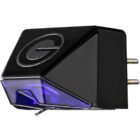
Colour: Violet
-
Cantilever: Aluminium
-
Stylus profile: Bonded super-elliptical
-
Stylus radius: 0.3 x 0.7 mil
-
Frequency range: 20 Hz – 20 kHz
-
Channel balance: ~1.5 dB @ 1 kHz
-
Channel separation: >20 dB @ 1 kHz
-
Sensitivity: ~3.5 mV (1 kHz @ 5 cm/sec)
-
Static compliance: ~20 mm/N
-
Vertical tracking angle: 20°
-
Recommended load: 47 kΩ & 100–200 pF
-
Internal resistance & inductance: ~410 Ω / 400 mH
-
Cartridge mass: ~6.9 g
-
Fixing centres: 12.7 mm (0.5 in)
-
Tracking force: 1.5–2.5 g (2.0 g recommended)
Design & Technology
-
Dual-magnet Magnetic Duplex Technology™ improves stereo accuracy and soundstage.
-
Pre-set azimuth / expert production adjustment simplifies installation.
-
User-replaceable stylus option for long-term use.
Performance – What Reviewers Say
-
Balanced, refined and detailed sound quality for its price range.
-
Delivers clear midrange, good dynamics and expressive vocals.
-
Bass is tight and informative, treble extended without being harsh.
-
Works well on a variety of music genres and affordable turntables.
-
Smoother and cleaner presentation than some entry-level cartridges, but slightly relaxed in delivery compared to very lively models.
-
Highly regarded for value for money; won What Hi-Fi? awards in its category.
Strengths
-
Excellent clarity and detail retrieval for a budget mm cartridge.
-
Easy to install and align.
-
Good stereo separation and rhythm handling.
Considerations
-
Not as powerful or dynamic as higher-end cartridges.
-
Some find it slightly warm or relaxed compared to more analytical models.
Q1: How does the super-elliptical stylus on the E3 affect tracking and detail compared to a spherical stylus?
Q2: What tonearm or turntable setups pair best with this cartridge for optimal performance?
Q3: What are the key differences in sound character between the E3 and Goldring E1 or E2 models?