

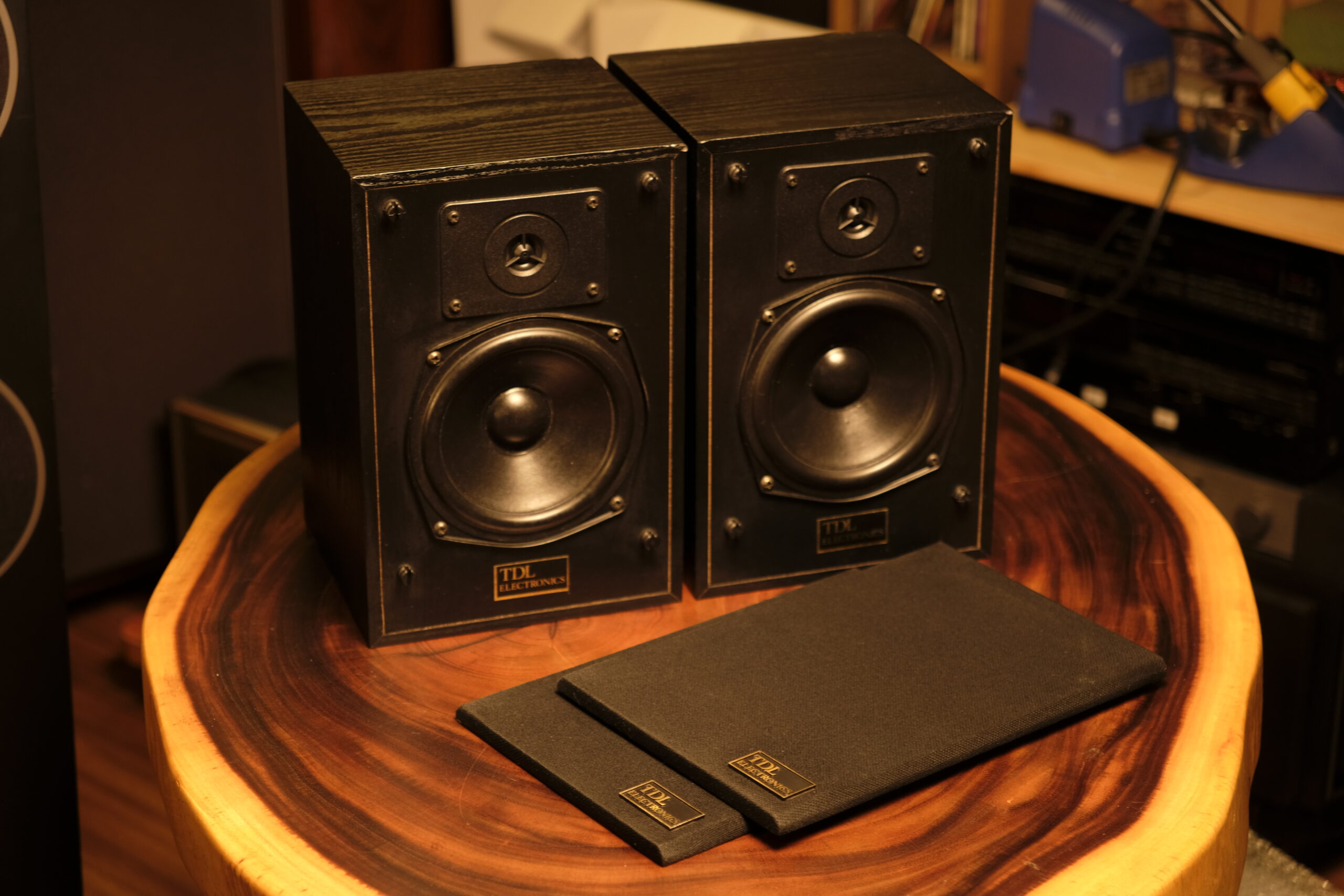

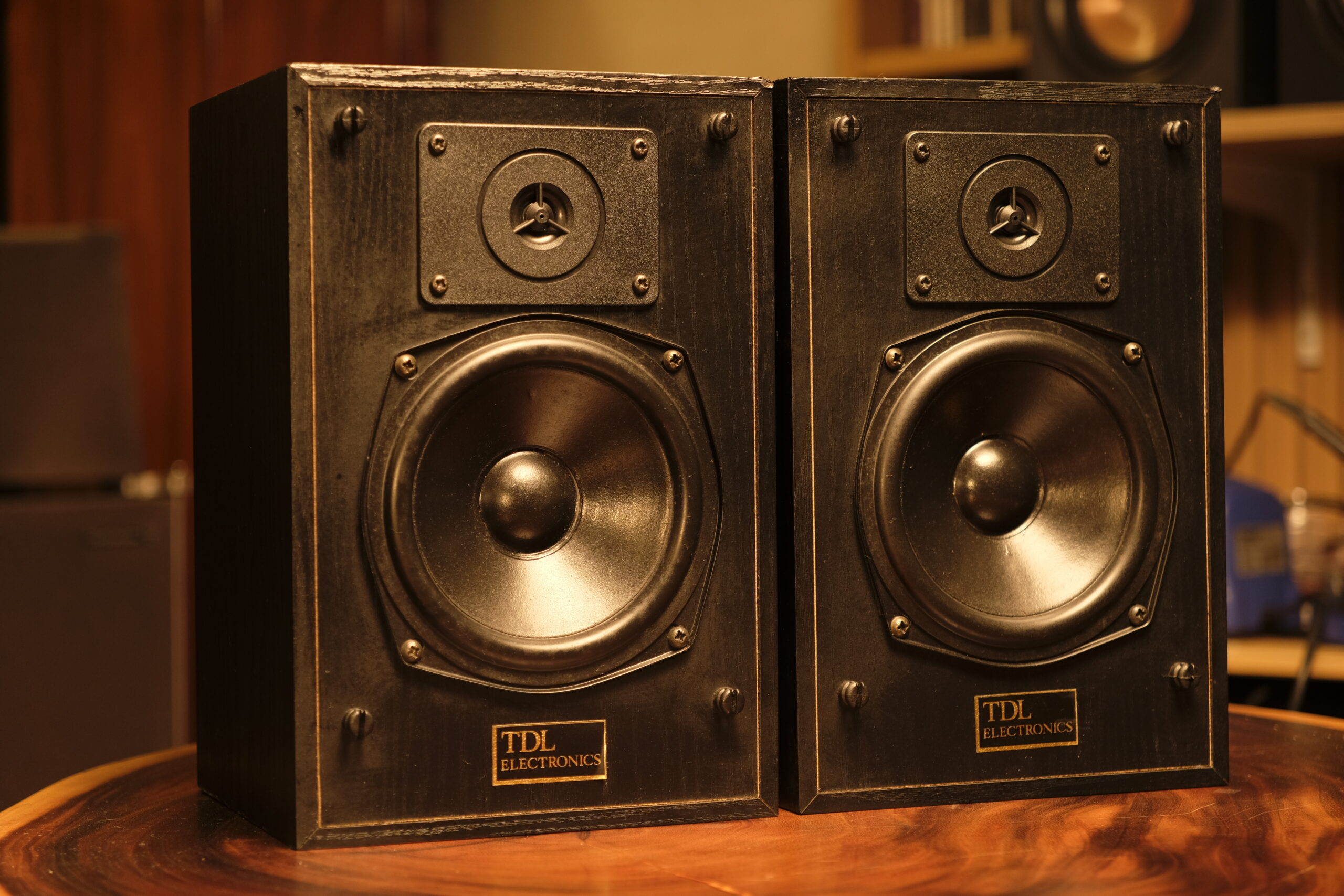

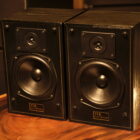


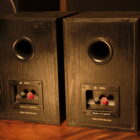

[SOLD] TDL Electronics Mini Near Field Monitoring Speaker Via Tweeters Ported Bookshelf
The TDL Near Field Monitor is a compact British two-way bass reflex loudspeaker introduced around 1993–1994. Unlike TDL’s famous transmission-line speakers, the Near Field Monitor was designed as an bookshelf monitor optimized for close listening distances in small rooms. It was intended for desktop, studio-style, or near-wall placement while retaining the balanced tonal character that TDL was known for.
Specifications
| Specification | Details |
|---|---|
| Type | 2-way bass reflex bookshelf speaker |
| Enclosure | Rear-ported bass reflex |
| Frequency response | 50 Hz – 20 kHz |
| Nominal impedance | 8 Ω |
| Sensitivity | 88 dB (1 W/1 m) |
| Recommended amplifier power | 15–60 W |
| Crossover frequency | 5 kHz |
| Woofer | 130 mm (5.25″) doped paper cone |
| Tweeter | 12 mm soft dome |
| Cabinet | MDF with vinyl veneer |
| Finishes | Black Ash, Rosewood |
| Dimensions (H × W × D) | 269 × 178 × 169 mm |
| Weight | 6 kg each |
Driver design
The woofer uses a 130 mm doped paper cone with a relatively large magnet, chosen for low coloration and a natural midrange. The lightweight cone provides quick transient response and excellent vocal clarity, though ultimate bass extension is limited by cabinet size. The tweeter is a 12 mm dome, derived from an Audax-style design, mounted behind a short waveguide that improves dispersion and integration with the woofer around the 5 kHz crossover.
Cabinet and crossover
The cabinet is constructed from 12–13 mm MDF with a rear tapered reflex port. Internal damping is moderate, balancing bass extension with efficiency. The crossover is intentionally simple, using a minimal number of components to preserve phase coherence and sensitivity. This straightforward design contributes to the speaker’s open, direct presentation.
Sound quality
The Near Field Monitor performs best at 1–2 metres from the listener. Imaging is precise, with excellent centre focus and good left-right separation. Vocals are clean and articulate, making acoustic music, jazz, and small ensembles particularly engaging. The paper-cone woofer gives instruments a natural timbre, while the compact cabinet disappears well in the soundstage.
Bass reaches approximately 50 Hz, enough for convincing low-frequency weight in a small room, although it lacks the authority of TDL’s larger transmission-line models. Treble is crisp and detailed, sometimes leaning slightly forward depending on partnering equipment. Several owners praise the speaker for its neutrality, imaging, and surprising bass for its size, while period reviews noted that it was less competitive in larger listening rooms than in its intended near-field application.
Amplifier matching
With 88 dB sensitivity and an 8 Ω load, the Near Field Monitor is easy to drive. It pairs particularly well with warm-sounding vintage amplifiers, including:
- NAD 3020
- Sansui AU-505
- Sansui AU-70
- Rotel RA-840BX4
- Luxman R-1040
These amplifiers complement the speaker’s slightly forward upper midrange with a fuller, smoother tonal balance.
Strengths
- Excellent imaging and stereo focus
- Neutral, natural midrange
- Easy amplifier matching
- Good efficiency for a compact speaker
- Clean vocal and acoustic instrument reproduction
- Surprisingly satisfying bass in near-field listening